
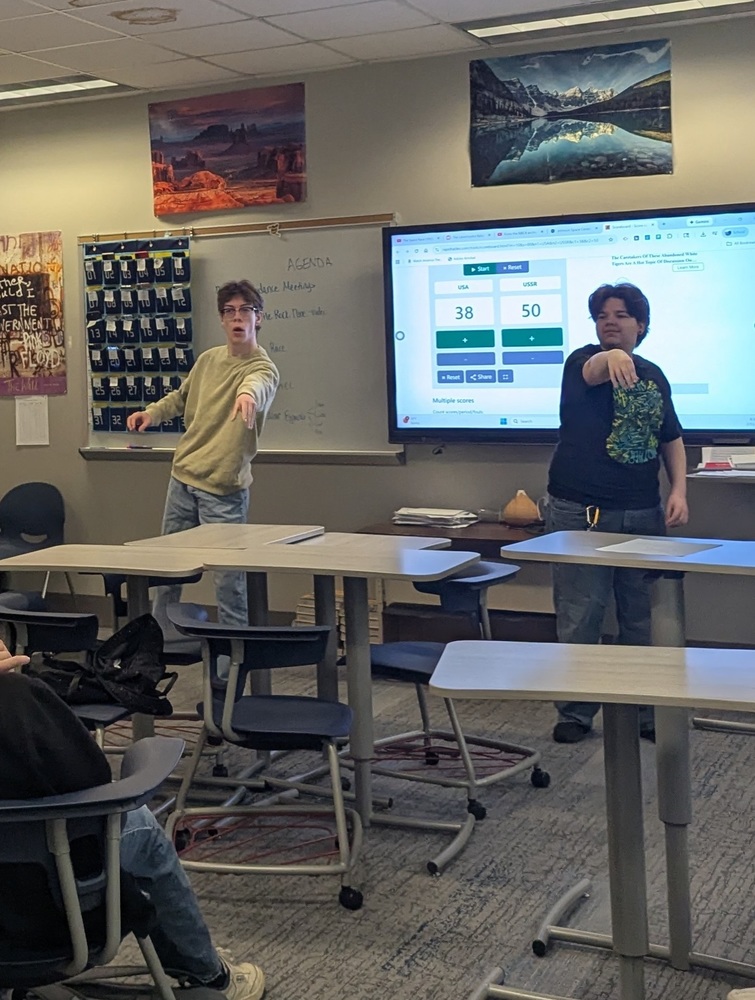
Students in regular U.S. History recently stepped back in time for an exciting, hands-on Cold War Space Race Simulation that brought the competition between the United States and the Soviet Union to life.
Classrooms were transformed into mission control rooms as student teams represented either the U.S. or the USSR in a head-to-head race to space. The simulation was designed to capture both the historical significance and the competitive intensity of the Cold War era.
The activity unfolded in three rounds:
Round 1: Space Race Trivia
Teams answered foundational questions about key events, milestones, and figures of the Space Race. Each correct answer earned points, reinforcing important historical knowledge while building early momentum for their team.
Round 2: Mission Control Challenges
Things quickly became more complex. Teams had to solve real-world inspired problems their spacecraft encountered — including fuel usage complications and adjustments to launch and landing windows. Students collaborated under pressure, just as scientists and engineers did during the height of the Cold War.
Final Round: Rocket Engineering
In the culminating challenge, students designed and built their own rockets — paper airplanes — and competed to see which team’s spacecraft would perform best. Strategy, design, and teamwork all played a role as the classroom turned into a launch site.
The simulation provided a dynamic way for students to experience the urgency, innovation, and rivalry that defined the Space Race. More than just a competition, the activity encouraged collaboration, critical thinking, and problem-solving — all while having a great time.
It was a fun and engaging way to learn about this pivotal era in history, and judging by the energy in the room, both superpowers would be proud!